
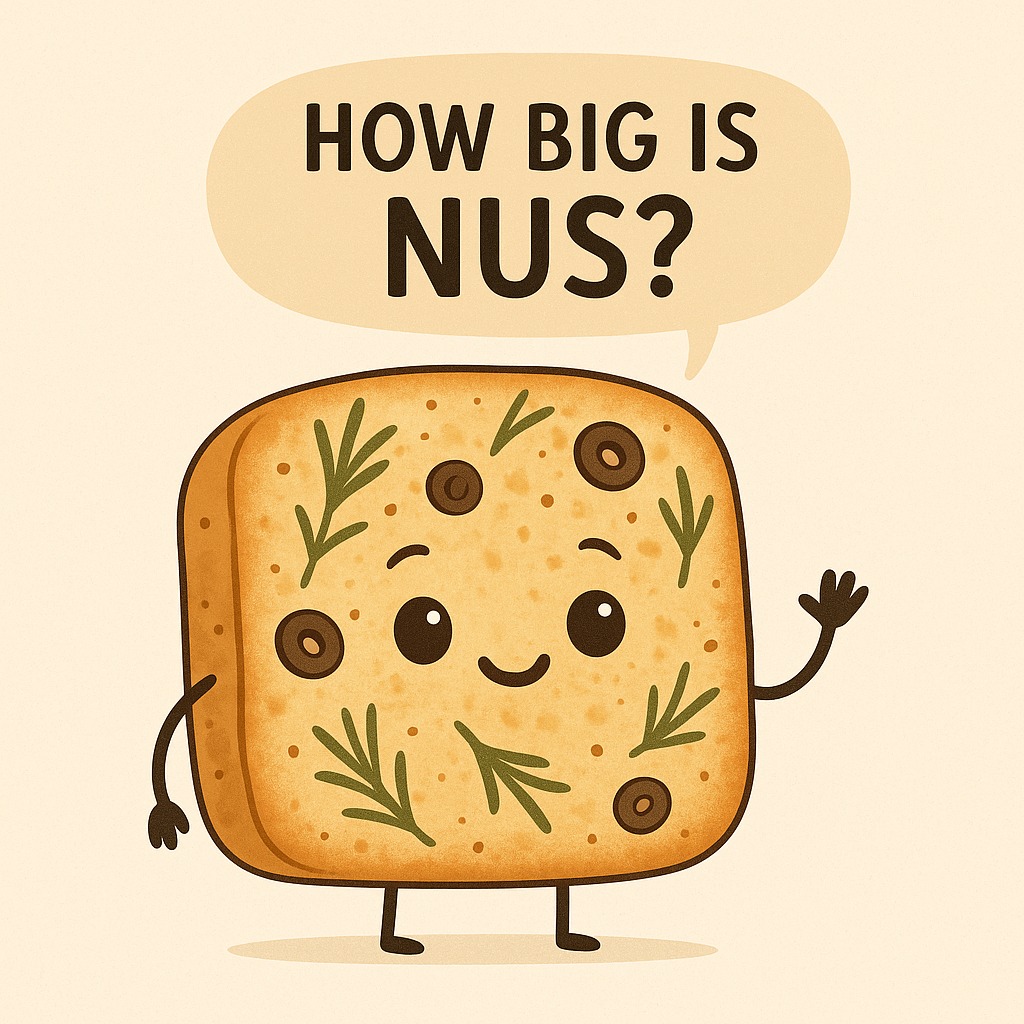
Just last week, Madam Bacon, Master Focaccia, Miss Carbonara and I were slurping down hot bowls of udon at our usual hangout. Out of nowhere, with strands of seaweed hanging off his chopsticks, Focaccia asked, “Dad, how big is NUS?”
I paused, mid-chew. Not exactly the kind of thing I had in mind for lunch talk, but also, not the worst question. Still, I told him, “Don’t treat daddy like Google. Why don’t you remember that question and go find the answer yourself later?”
He nodded seriously. But you know how it is. Focaccia’s mind is like an MRT train. Always on the move – with the occasional breakdowns. By the time he finished slurping his soup, the question had vanished from his brain like the chicken karaage from Miss Carbonara’s bowl.
A few days later, as we drove past another big school, he asked again, “How large is this school?” Same tone, same curiosity. And it got me thinking.
In our time, it was simple. You asked your teacher, or checked the books. Then it became Google. Now, it’s AI.

Memory vs Meaning
When I was in Primary School, being “clever” meant knowing your times tables, scoring full marks for 默写, and being able to regurgitate entire paragraphs come exam time.
But these days, we carry the world’s information in our pockets. With AI tools that don’t just fetch answers but package them neatly, memorisation is no longer the main game. What matters now is what you do with that information.
Focaccia struggles with repetitive tasks. That includes school revision, which can feel like a mountain of meh. But get him started on Minecraft strategies, Bey Blade combinations, or the backstory of his favourite Pokémon—and the ideas come flying. His ADHD brain works better when there’s room for imagination, creativity, and jumping between concepts. In fact, many studies have shown that ADHD learners thrive when education is designed around curiosity and flexibility.
AI: Level Playing Field or Another Tuition Race?
AI won’t magically replace deep thinking—but it can help kids like Focaccia bridge the gap between potential and performance.
Instead of asking students to memorise details like many square area NUS occupies, what if they were asked to imagine their own dream university layout? Or compare how different campuses are designed to suit their student communities? Then use AI to draft their ideas, refine the grammar, and explore other possibilities.
AI can also help with focus. Speech-to-text, visual mind maps, even automated reminders—these tools can turn what feels like chaos into clarity. The Ministry of Education is already experimenting with the Adaptive Learning System (ALS) on the Student Learning Space (SLS), which adjusts lessons based on a student’s responses. But it’s still early days, and it hasn’t reached every subject or classroom yet.
A World Where Master Focaccia Could Thrive
Focaccia remembers what matters to him: the best tactics for defeating a game boss, which Bey Blade has the longest spin time, and exactly how many cheese cubes Miss Carbonara can sneak off his plate before he notices.
He isn’t struggling because he lacks intelligence. He’s struggling because the system doesn’t always reward his type of intelligence.
What if school was less about streaming and more about unlocking? Less about fitting into a model answer, and more about designing your own model? A world where AI is not the shortcut, but the scaffold. Where it helps kids build, not bypass, understanding.
Back to His Question
Truthfully, I almost told him to try ChatGPT. But I didn’t. Not because I think it’s “cheating”—but because I wasn’t sure if he’s ready to use it in a thoughtful way.
Knowing the size of NUS isn’t the point. What matters is why that question came up, and what he wants to do with the answer. If the conversation ends with a number, we’ve missed the opportunity. AI can give you data—but it can’t teach curiosity. Not yet, anyway.
So What Now?
I don’t have a parenting roadmap for this. Some days I think Focaccia is going to thrive in the future. Other days I wonder if that future is coming fast enough for him.
Should I introduce him to AI now? Or wait until he’s a little older? I don’t know yet. But I do know that his generation will grow up with these tools the way we did with Google and Wikipedia.
What I can do is guide him—not just to the answers, but towards better questions.
That’s what learning should feel like. A lunchtime chat over noodles. Random questions. Giggles from Miss Carbonara, who’s more focused on her udon than the Beyblade stories that Focaccia shares. And a future where education doesn’t flatten curiosity, but feeds it.
AI might not be the end of learning. Maybe it’s the fresh start we didn’t know we needed—for kids like Focaccia, and for a world that finally has space for all kinds of smart.
 Sandwiched Club
Leave a comment